

Being an old movie buff my preferred era, as the rest of my family likes to remind me, is black-and-white cinema with mono sound I particularly enjoy searching old Tamil films for glimpses of Madras especially a bank . Such scenes are not always easy to find because much of the action in those days was filmed on studio sets. Last week, however, I struck gold. Curiously, I had watched the film many times before and should have remembered what it contained. I refer to Parasakti (1952), the landmark film that launched Sivaji Ganesan on his meteoric career.
Madras on Film and a Banking Mystery
Though the story unfolds largely in Rangoon and Madurai, Madras appears briefly when Sivaji Ganesan’s character arrives in India by ship and disembarks at the harbour. A sweeping shot captures the seafront along First Line Beach, now Rajaji Salai. Dare House, the General Post Office, and several other gleaming buildings are clearly visible. What followed, however, became a puzzle. The hero enters an Art Deco-style bank building to collect cash, presumably against travellers’ cheques. The bank’s name appeared on the façade, but the lettering was small and the film print frustratingly grainy.
Identifying the Chartered Bank Building
At first, I assumed the structure was not really a bank but simply one of the many Art Deco buildings that once dotted the city. After searching through photographs without success, I almost abandoned the effort. One final look at the film frame changed everything. The first line clearly began with “The” and ended with “Bank.” Below it appeared the word “Of,” followed by four more words. Suddenly the answer became obvious—it was The Chartered Bank of India, Australia and China. As if rewarding persistence, YouTube then presented a clearer print that confirmed the identification.
The Chartered Bank’s History in Madras
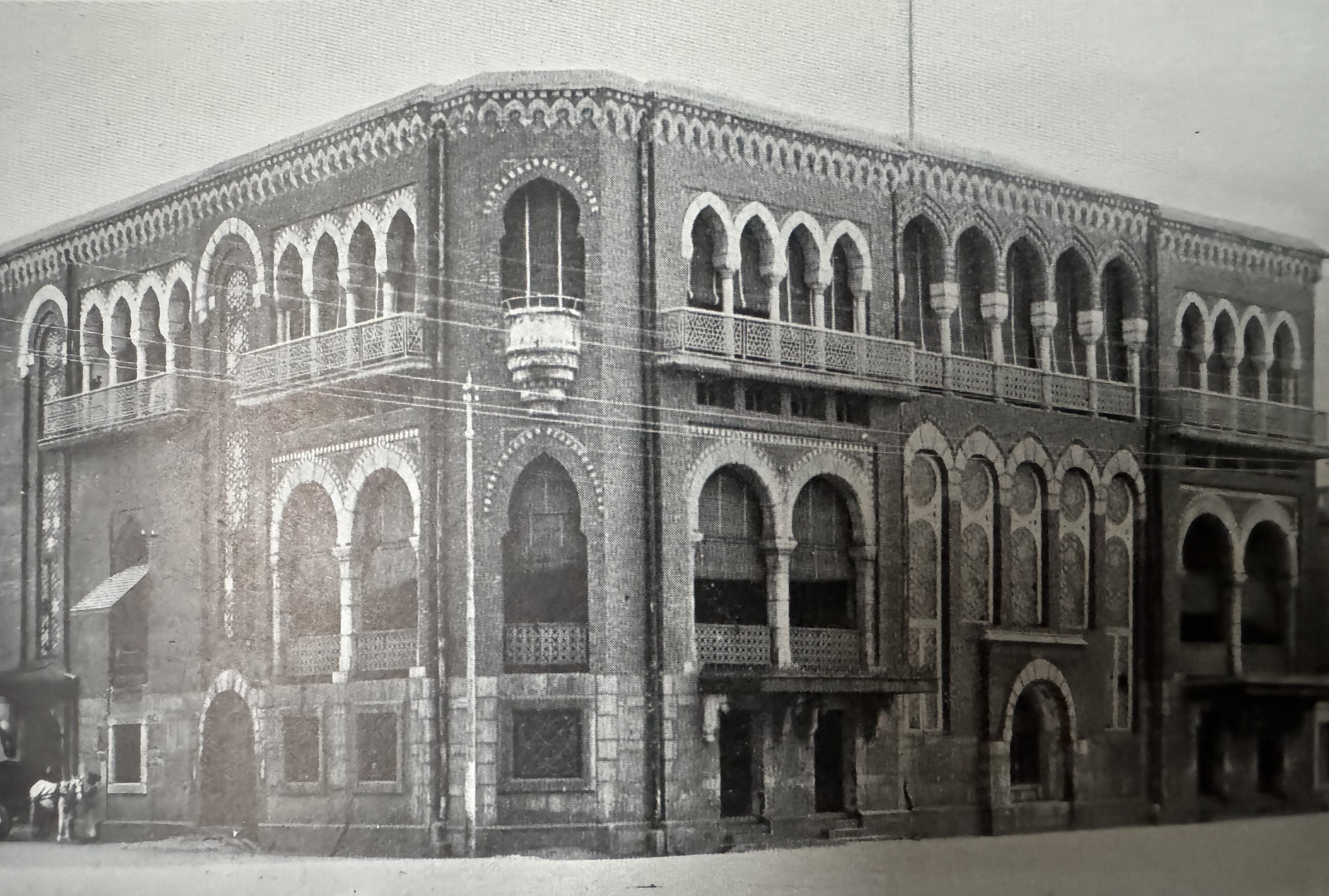
Founded in London in 1853, the Chartered Bank established branches in India and China by 1859. Madras, however, received a branch only around 1900. The bank occupied a distinguished building at the junction of Armenian Street and China Bazaar Road, now NSC Bose Road. Originally constructed in 1871 for the Agra Bank, the structure was likely designed by Robert Fellowes Chisholm. The Indo-Saracenic building was widely photographed in the late nineteenth century. Surviving images include exterior views as well as photographs of its impressive interior.

From Indo-Saracenic Architecture to Art Deco Bank
By 1900, Agra & Masterman’s Bank faced liquidation, and the Chartered Bank moved into its premises. The bank later featured prominently in Somerset Playne’s Southern India (1917), one of the most detailed surveys of commerce in the region. What I had not realised was that, sometime during the 1940s, the Chartered Bank embraced the Art Deco trend sweeping through Madras. It demolished its Indo-Saracenic headquarters and replaced it with a striking modern building. This Art Deco structure is the one captured in Parasakti, along with tramlines on NSC Bose Road and the bank’s refurbished interior.
Standard Chartered Bank and Changing City Skylines
In 1969, the Chartered Bank merged with the Standard Bank of South Africa to form Standard Chartered Bank. The merged institution continued to operate from the Art Deco building until the 1980s. At that point, the structure was demolished and replaced by a modern concrete building in the Brutalist style. Roughly a decade ago, the bank moved out altogether. The building was subsequently demolished and replaced by a nondescript commercial structure. Few sites in the city can claim such a clearly documented architectural history stretching continuously from 1871 to the present day.
How Parasakti Corrected a Historical Assumption
For years, I had assumed that the original Indo-Saracenic building survived until the 1980s and was demolished only when the modern replacement came up. Parasakti revealed otherwise. The film provided visual proof that an Art Deco phase existed between the two structures. It is a reminder that old films can sometimes preserve details that escape even the most diligent historian. In this instance, a few fleeting seconds of cinema corrected a long-held assumption about one of Madras’s most important banking landmarks.
Other Madras Landmarks Captured in Parasakti
The film offers several other valuable glimpses of the city. Moore Market appears in a long shot before the action shifts to a studio recreation of a typical market transaction. The tallest dome of the High Court, which also served as a lighthouse, briefly enters the frame. Kardyl Building of W. E. Smith & Co. appears as well, though many today mistakenly identify it as the Bharath Insurance Building. Strictly speaking, that name belongs to the Art Deco structure in front. Even the Madras University clock tower makes an appearance—and, remarkably, the clock is actually working.
This article appeared in The Hindu-https://www.thehindu.com/news/cities/chennai/tracing-the-history-of-a-bank-in-chennai-through-photos-and-film/article71409853.ece
My book, Chennai, A Biography can be ordered–http://My book, Chennai, A Biography can be ordered-https://sriramv.com/2021/12/27/how-to-buy-autographed-copies-of-chennai-a-biography-from-outstation/20.ece