

Last week, in preparation for Madras Week, Rajiv Kripalani of ChennaiLive 104.8 FM invited me to a podcast. I made it clear that I did not want to speak about my journey in heritage, place names, or pin codes. In response, he asked me about AI, a subject about which I know next to nothing. That led to a discussion on how technology has shaped the growth of our city. As I reflected on the subject, I began to see certain patterns emerge. The story of Chennai, in many ways, is also the story of technological change and adaptation.
Weaving Technology and the Early Growth of Madras
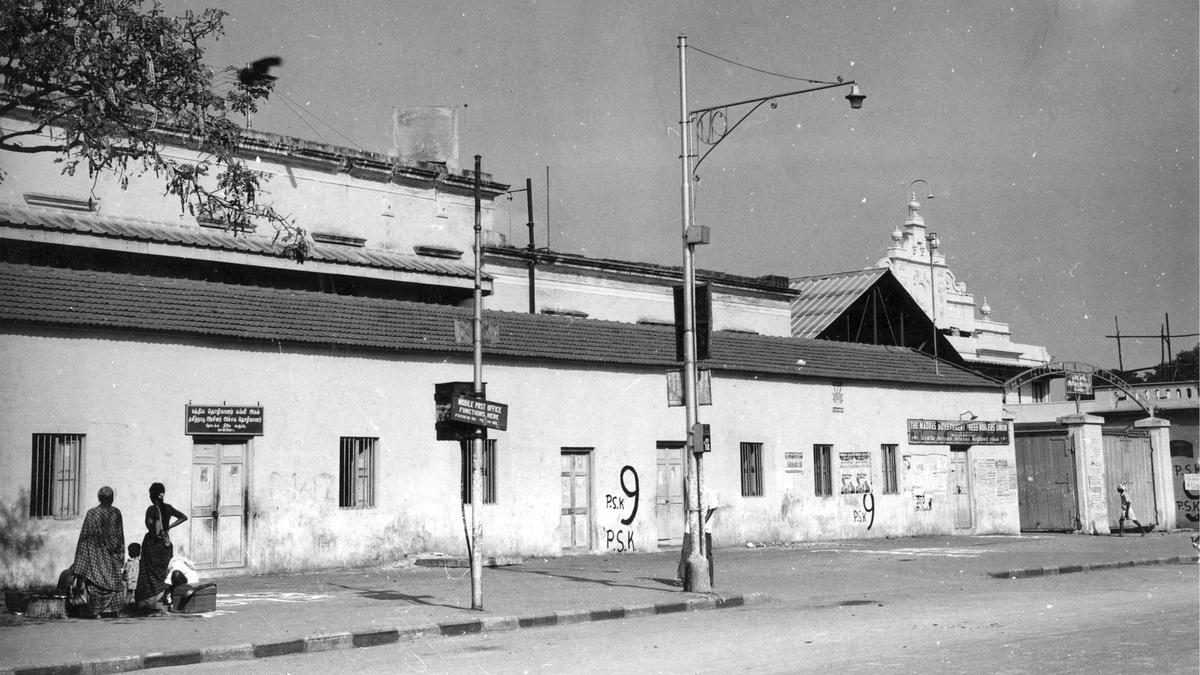
Technology may be defined as the scientific knowledge and equipment needed for a particular industry. By that definition, weaving was the first technology that attracted colonial interest to our region. While the principal weaving centres lay in the hinterland, places such as Chintadripet, Colletpet (Kaladipettai), Saidapet, Mylapore, and Mambalam became important production hubs over time. The various mints of Madras brought their own technological requirements. Tankasalai, now Thangasalai Street, still commemorates that legacy. Interestingly, the mint never printed notes. Instead, printing technology became the defining industry of Mint Street for nearly a century.
Printing Technology and the Rise of Mint Street
Numerous typesetting presses flourished along Mint Street, turning it into the centre of the city’s publishing industry. Many of Madras’s most influential newspapers, journals, and books began life here. Printing technology transformed the area into a hub of intellectual and commercial activity. The concentration of presses encouraged literacy, journalism, and political debate. In many ways, the printed word helped shape public opinion in the city. Long before computers and digital media arrived, Mint Street represented the cutting edge of information technology in Madras and stood at the heart of the city’s publishing ecosystem.
Water Management Technology in Madras
The city’s engagement with water technology survives in place names even today. Seven Wells, remembered both in George Town and at St Thomas Mount, commemorates early efforts to provide drinking water. Several Pumping Station Roads similarly preserve memories of infrastructure that once played a vital role in civic life. Two Lock Nagars, located at Chepauk and Kotturpuram, recall the locks that regulated water flow into the Buckingham Canal. These engineering interventions ensured navigability and improved transportation. Though largely forgotten today, they represent significant technological achievements in managing water within the city’s growing urban landscape.
Railway Technology and Industrial Expansion
Heavy machinery arrived with the railways and transformed the city’s industrial profile. Perambur developed around the railway workshops, locomotive works, and carriage factories. The growth of Binny Mills nearby strengthened the concentration of engineering industries in the area. This industrial belt extended northwards through Tiruvottriyur and WIMCO Nagar, while to the west it reached Avadi and Ambattur, where the TI Group established a major presence. After Independence, several British business houses attempted to industrialise and Indianise their operations by setting up manufacturing facilities here. Among them, MRF emerged as one of the most successful enterprises.
Engineering Industries Across North Madras
The Amalgamations plants at Sembium represented the next stage of industrial development. Later came the expansion of TVS facilities at Padi, strengthening Chennai’s engineering base. Combined with the Ambattur Industrial Estate and the defence establishments further west, they created a continuous industrial corridor stretching from Royapuram to Tirumazhisai and beyond. Industrial growth also extended northwards towards Ennore, where Ashok Leyland established operations, and to Manali, which became associated with chemical industries. These developments helped define the economic geography of northern Chennai and laid the foundation for large-scale manufacturing in the region.
South Chennai’s Technology and Industrial Growth
In South Chennai, the establishment of the Guindy Industrial Estate, the first of its kind in South India, marked a turning point. Unlike the north, this region focused largely on light engineering industries. Rayala became a prominent name through its manufacture of Halda typewriters and Facit calculating machines. Rane subsequently established operations in Velachery and Alandur, contributing to the growth of localities such as Nanganallur. By the 1990s, industrial expansion had pushed further south towards Maraimalai Nagar. Tanneries in Pallavaram and aromatic industries such as Ponds and Maschmeijer had already established a presence in the area.
Technology Education and the Rise of the IT Corridor
A crucial factor in Chennai’s technological growth was the educational hub around Guindy. The College of Engineering, Guindy, the AC College of Technology, IIT Madras, and the Central Polytechnic campus created a strong knowledge ecosystem. Institutions such as CLRI and later NTTF further strengthened this network. Together, they produced the skilled workforce needed for industrial and technological advancement. This concentration of expertise eventually seeded the growth of the IT corridor along Old Mahabalipuram Road. Knowledge parks, software firms, and high-technology companies emerged along this route, transforming South Chennai into a centre for modern innovation.
AI Technology and Chennai’s Future
Seen against this backdrop, the recent Tamil Nadu budget announcement regarding an AI City becomes especially significant. The location has not yet been revealed. Ideally, such a project should be established in a greenfield area near major tier-two cities such as Tiruchirappalli, Madurai, or Coimbatore. That would encourage balanced regional development while reducing pressure on Chennai’s infrastructure. However, given Chennai’s existing ecosystem of industries, educational institutions, and technology companies, it seems likely that the proposed AI City will emerge somewhere close to the metropolitan region. Existing advantages often shape the direction of future investments.
From Weaving Technology to Artificial Intelligence
Starting with weaving technology, Chennai has travelled a remarkable distance to arrive at artificial intelligence. Every phase of its development has been linked to innovation, industry, and the adoption of new technologies. From mints and printing presses to railways, factories, engineering hubs, educational institutions, and information technology parks, each stage has left its mark on the city. The proposed AI City represents only the latest chapter in that long story. Ultimately, it is excellence, creativity, and innovation that will determine whether Chennai continues to thrive as one of India’s leading centres of technology.
This article appeared in The Hindu–https://www.thehindu.com/news/cities/chennai/madras-the-tech-city/article71331839.ece
My book, Chennai, A Biography can be ordered–http://My book, Chennai, A Biography can be ordered-https://sriramv.com/2021/12/27/how-to-buy-autographed-copies-of-chennai-a-biography-from-outstation/20.ece
You have an excellent detail of how Madras contributed to various industries. Superb.