

Last week I led a walk on Independence Day to commemorate the freedom markers of Mount Road. It was a study I had long wanted to take up. In my view, much of the history of the freedom struggle in our city is centred on George Town, the Marina, Thiruvallikeni and Mylapore. Mount Road, however, has its own story to tell. And it turned out to be a worthwhile route, taking us through places connected with the freedom movement, the press, cinema, literature, copyright battles, Partition and the removal of imperial symbols.

The Hindu and the Freedom Struggle
The walk, appropriately enough, began at The Hindu, the paper that steadfastly championed the cause of freedom. In keeping with that spirit, all participants were given a freshly printed copy of The Hindu’s August 15, 1947 edition. From there, we went to The Mail, whose offices were next door. Now defunct, it represented British interests until Independence. Its support to Arbuthnot & Co following its collapse in 1906 played a role in Indians veering towards The Hindu. Thus, our Markers walk began with two newspapers that represented contrasting positions during a crucial period in the city’s history.
Freedom markers and Foreign Goods on Mount Road
Our next stop was where the showroom of Kishinchand Chellaram once stood. Mahatma Gandhi had asked Congress volunteers to picket shops selling foreign goods. It is my view that the focus was largely on Indian-owned outlets dealing in such products. Much of the picketing therefore took place outside shops in the China Bazaar area. There was hardly any on Mount Road, where European establishments mainly sold to Europeans. Chellaram’s was the exception. Its showroom became one of the Mount Road locations targeted by the picketers, providing another physical reminder of the economic dimensions of the freedom struggle.
Thyaga Bhoomi and the Freedom Struggle
We then went to Blackers Road, where Gaiety Palace marks the spot where the eponymous theatre once stood. This was where the film Thyaga Bhoomi was screened in 1938. Kalki’s novel, themed around struggles against colonial, caste and patriarchal oppression, became a landmark film. It has also generated several apocryphal tales, including stories of a ban order on the film and a lathi charge inside the theatre. These stories demonstrate how the freedom struggle itself could spawn fictional narratives. Yet, regardless of the legends that later grew around it, the film was undoubtedly an inspiring work.
Bharathi and Swadesamitran on Mount Road
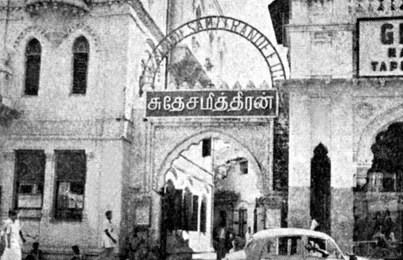
From Gaiety, we went to the VGP building, once the offices of Swadesamitran when the building was known as Victory House. Subramania Bharathi is the name most closely associated with the paper, though it did not function from this building until after his death. Bharathi thereafter became a running theme of the walk. Our next stop was the DBS Building, where Saraswathi Stores once stood. This was AVM’s outlet for gramophone records. Bharathi’s songs had been banned shortly after his death. His wife later sold the copyrights to the Broadcast gramophone label, from which Meyyappan bought them for his 1947 film Naam Iruvar.
With Independence, the Government of Madras, through the efforts of Avinashalingam Chettiar, then a minister, lifted the ban on Bharathi’s songs. It also persuaded Meyyappan to free the works from copyright and ensured that Bharathi’s wife received due compensation. If freeing copyright was the theme at Saraswathi Stores, outside Higginbothams it was the struggle to establish copyright. This centred on a portrait of Mahatma Gandhi by the patriot Arya Bhashyam. He famously refused a freedom fighter’s pension and made a living by painting portraits of freedom fighters. His Gandhi portrait later became the subject of a copyright dispute
Gandhi, Bhashyam and the Copyright Battle
Bhashyam gave his picture of Gandhi to the Associated Press in the 1960s for block making and printing. The company functions from the rear of Higginbothams. Imagine his shock when he discovered that, after fulfilling the contract, the company had begun selling prints of the picture under another artist’s name. This led to litigation, which Bhashyam eventually won. The stop therefore brought another dimension of the freedom struggle into focus. It was no longer simply about political independence. It was also about protecting the rights of individuals whose work and identity could otherwise be appropriated.
Mount Road and the Story of Partition
Standing outside Quaid-e-Milleth College and facing Agurchund Mansions, I am always reminded of Partition. Mohammad Ismail, who was given the title Quaid-e-Milleth, or leader of the nation, was one of the founders of the Indian Union Muslim League. As the name suggests, it strongly opposed dividing the country. The college was named after him. On the other side of Mount Road stood what was once Khaleeli Mansions, built by Agha Mohammad Khaleel Shirazi. In 1947, the building was owned by his son, Abbas Khaleeli, ICS, who migrated to Pakistan. Declared evacuee property, the building was auctioned and purchased by Sah Agurchund Manmul.
The James Neill Statue and Freedom markers
Our final stop was the empty pedestal at Spencer junction. On this site once stood the statue of Colonel James Neill, erected as a symbol of British victory in 1857. Much hated by Indians, the statue became the subject of the first protest against a symbol of imperialism anywhere in the country. The campaign lasted from the early 1920s until 1937, when the newly elected Rajaji Government ordered the statue to be moved to the museum vaults, where it remains. Many unknown heroes and heroines participated in this struggle, and it also witnessed the rise of K Kamaraj.
Preserving the Freedom Markers of Mount Road
Most of these landmarks now exist only in books. The physical places remain, but their connections with the freedom struggle are rarely visible to those who pass them every day. It would therefore be good if the Greater Chennai Corporation considered installing blue plaques to commemorate them. Such markers would not merely identify old buildings or forgotten sites. They would help connect the present city with the people, events and struggles that shaped its history. Mount Road has many such stories, and preserving these freedom markers would ensure that they do not disappear entirely from public memory.
This article appeared in The Hindu–https://www.thehindu.com/news/cities/chennai/freedom-markers-of-chennais-mount-road/article71361882.ece
My book, Chennai, A Biography can be ordered-http://My book, Chennai, A Biography can be ordered-https://sriramv.com/2021/12/27/how-to-buy-autographed-copies-of-chennai-a-biography-from-outstation/20.ece
Superb Sriram. Very informative and interesting.