

This article was written for a special souvenir released by the District Grand Lodge of South India to commemorate the centenary of Freemasons’ Hall and is published here with kind permission. Hundred Years of a Masonic Temple is a unique record indeed.

Opening of the Freemasons’ Hall

It was on February 26, 1925 that Lord Goschen, then Governor of Madras, declared open the Freemasons’ Hall in Egmore. It was a dream come true for the brotherhood in Madras. Just three decades earlier, the Rev C.H. Malden, writing his History of Freemasonry on the Coromandel, had despaired of the DGL of Madras ever having a home of its own. “…nor does it seem likely that such a building will ever be erected in Madras,” was his last lament on the subject. And yet, a decade after that book was written, everything fell into place. The DGL moved to its first home in 1905 and then to its second and permanent home in 1925.
Early Masonic Temples in Madras

Before we move on to how the DGL came to acquire the land and then put up its iconic Masonic Temple in Madras, a quick survey of all the places that it used earlier would be of interest. The Fort was definitely where Masons met, and as documented elsewhere, there clearly was a Temple in the premises, though its whereabouts cannot be identified with any certainty now. HD Love in his Vestiges of Old Madras states that there was a Masonic Temple in Egmore, on the site where the St. Andrews Kirk stands today.
Nothing is known of this building either. That there were meetings elsewhere, particularly at the Old Jail premises (below) at the end of Broadway is also documented.
Lodge of Perfect Unanimity and General Collins
The Lodge of Perfect Unanimity (PU), which was primus inter pares among all the Lodges first met at the Fort and later General Collins Road, Vepery. The man after whom the road takes its name was a Mason too and in 1799, the earliest date to which the minutes of the DGL can now be traced, was acting Provincial Grand Master (PGM). The first recorded meeting of the DGL, which took place on July 9, 1799, was held at General Collins’ house and so we can assume that this was the DGL’s address then.
The Pantheon and Financial Struggles
In 1800, Lodge PU began meeting at the Pantheon, on Pantheon Road, the premises now occupied by the Museum, Connemara Public Library and the Museum Theatre. The DGL, or PGL as it was then, conjointly hired the premises. The monthly rent was 15 pagodas, which Lodge PU paid in full and levied a charge of five pagodas on the DGL as a sub-tenant. But such was its impoverished condition that the DGL was continuously in arrears over its rent. In 1811, we find Lodge PU sending a bill of 280 pagodas to the DGL, for rent due for over five years!
Changing Locations and Lodge PU’s Lead
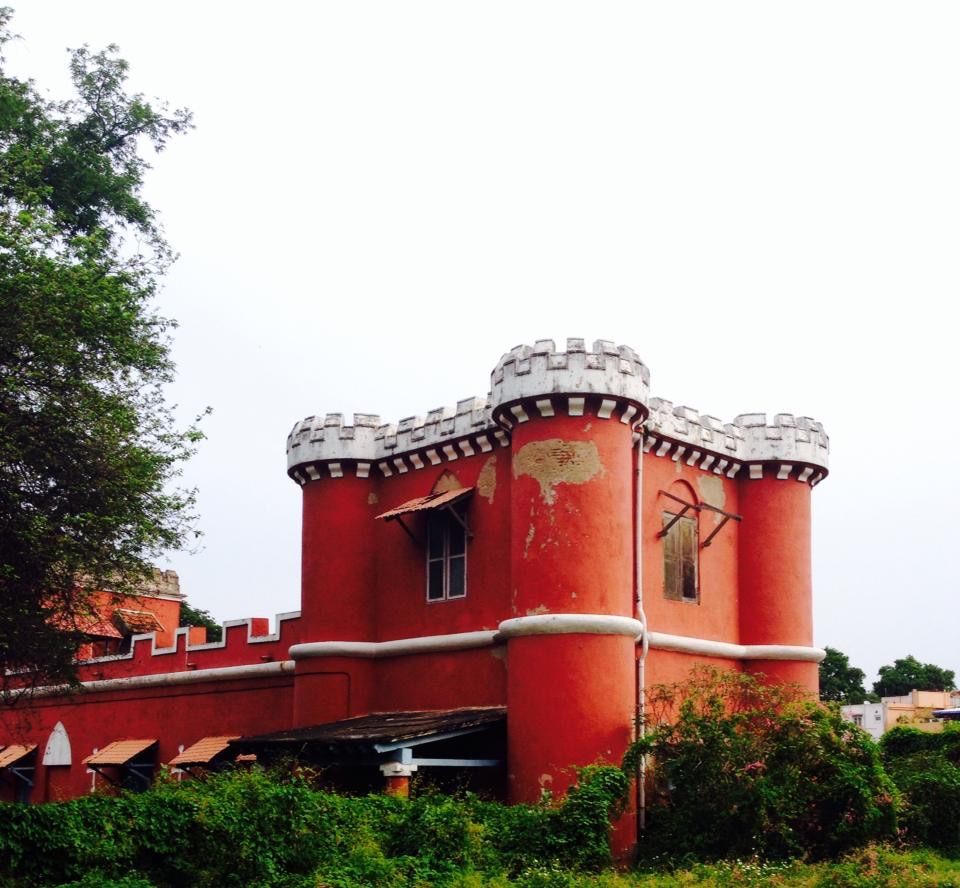
In the interim the DGL appears to have rented a house by the Spur Tank for use as its office. However, the Pantheon, being the principal venue for all social entertainments in the city, appears to have been the place where all Masonic activity took place. A letter in 1812 shows that the Lodge of Unity and Friendship met “at a bungalow at Egmore, formerly occupied by Lodge St. Andrew, immediately in rear of the Pantheon”. The next move by Lodge PU, the DGL in tow, was to College House in College Road. This building still stands, in the campus of the Directorate of Public Instruction.
The Beach Masonic Temple and Further Relocations

Lodge PU took the lead in building a temple, by the beach in the late 1830s. When this location proved unpopular, it rented out the place and shifted to Mount Road and from there to Vepery. A tenant at the beach premises was the Madras Police and they liked it so much that they bought the place off the PU and it is now the headquarters of the Tamil Nadu police. The office of the Director General of Police still has Masonic symbols on its cornice.
The Move to Mount Road

By the late 1870s, Vepery was yielding to Mount Road as the Masonic choice. In 1877, Lodge PU was on the lookout for premises on that principal thoroughfare of Madras. The short-lived Lodge Pilgrims of Light had literally shown the way, for its premises, on property belonging to Mr. Garratt, the tailor was available. Negotiations took another six years and in 1883, Lodge PU purchased the building for Rs 18,000. The first meeting there took place on January 7, 1884.
Financial Challenges and Reluctance to Share
A proper Masonic building was put up here, courtesy the brilliant architect R.F. Chisholm who was a Mason himself, belonging to Lodge PU. But the property proved a cash guzzler. Debentures were issued for Rs. 3,000 in 1896 to fund new repairs and a further borrowing of Rs. 2,000 was resorted to in 1899 for building a compound wall. By 1897, with more money being needed for further repairs, the Lodge PU was at its wits’ end. It could have rented the place to other Lodges but it was not entirely comfortable with sharing its premises.
The Push for a Common Masonic Temple
Thus when Lt. Col Sir George Moore suggested that the then under construction Victoria Public Hall be part funded by Masons so that one wing could be used as a Masonic Temple, it was the Lodge PU that refused, thereby aborting the scheme. It attributed “the present indifferent accommodation to the fact of the rooms being used in our absence by other Lodges,” and cited this as the reason for not helping out with building a common Temple. This stubbornness would however change in the new century.
Acquisition of New Property in Egmore
The idea of having a temple on Mount Road was not given up. This was around the time that the Lodge PU began to come around to the idea that a common Masonic Temple may not be so bad after all. It offered its property to the DGL. Negotiations commenced and in 1905, hands were shaken in agreement. The property of 55 grounds (roughly three acres) was valued at Rs 80,000 of which Rs 5,000 was to be paid at once in cash, Rs 10,000 by means of debentures at four percent payable in 1921 and Rs 65,000 by means of interest-free debentures payable in 1956.
Construction and Final Establishment of the Masonic Temple
The DGL took over the property in 1905 and the minutes of April 29 recorded its gratitude to Lodge PU –“DGL hereby places on record its grateful sense of the liberal and Masonic spirit in which Lodge PU has come forward and placed its property at the disposal of DGL thereby making the scheme for a Masonic Temple practicable, and conferring a lasting benefit upon Freemasonry in the District.”
The Search for a Better Location
The building however needed several improvements and so the Masonic Hall at Vepery became the temporary residence for the Lodge PU and the DGL till repairs were completed. But even then, the building was found to have several design defects. However, the idea of a common Temple had taken root and so now the question was of either building a new modern facility on the same land or moving elsewhere together.
The Final Decision
In 1914, Bro. H.B. Pierce, who was then District Grand Superintendent of Works (DGSW), studied the building then in use and gave a report that concluded that it would be better off to sell the place. In 1916, a committee was formed to study the alternatives. It unanimously recommended selling the Mount Road premises and moving to a new property available at Egmore. The new site had been located by Pierce who also gave a sketch for a proposed building at that location.
This article appeared in Madras Musing – https://madrasmusings.com/vol-34-no-23/hundred-years-of-a-masonic-temple/